
If a raw material arrives late, does not meet the required specification or costs more than your procurement budget allows, production can quickly fall behind schedule.
Preventing shortages requires more than placing orders early. You need a procurement plan that connects production demand with supplier capacity, replenishment time, material quality and the risks attached to each source. The objective is to secure the right material, in the right quantity and specification, before it is needed on the production floor.
What causes raw material shortages in manufacturing?
A shortage can begin long before stock runs out. An inaccurate production forecast may underestimate material requirements, while a delayed purchase order can leave insufficient time for replenishment. Other causes include supplier capacity constraints, rejected deliveries, unexpected increases in demand and reliance on a single supplier.
Imported materials introduce additional considerations. Shipping schedules, port congestion, customs clearance, inland delivery and foreign-exchange movements can affect both arrival dates and landed costs.. For your procurement team, the implication is clear: a supplier’s estimated dispatch date is not the same as the date a material will be ready for production.
Build your procurement plan around production demand
Start with the production schedule rather than the supplier’s available quantity or minimum order requirement. Identify the materials needed for each production batch, how much each batch consumes and when those materials must be available.
Your material requirement should account for:
● Specification and grade: Confirm the exact material, grade, purity or technical standard required.
● Consumption rate: Calculate the quantity needed per batch, including expected process losses.
● Production dates: Identify when each material must be available for use.
● Existing commitments: Account for usable stock and confirmed incoming orders.
● Purchasing restrictions: Check minimum order quantities (MOQs), packaging sizes, storage conditions and shelf life where applicable.
This information helps you avoid two costly situations: ordering too little and interrupting production, or buying more than you can use within a reasonable period.
How much safety stock should you maintain?
Safety stock is additional material held to protect production against unexpected demand or replenishment delays. It should reflect the risk associated with each input rather than an arbitrary percentage applied across every product.
For example, a specialised chemical with limited alternative suppliers may require a larger buffer than a commonly available packaging material. However, excessive safety stock ties up working capital and can create storage, deterioration or expiry problems.
A useful starting point is the reorder point:
Reorder point = Expected demand during lead time + Safety stock
Suppose your factory consumes 100 units of a material daily. If replenishment takes 10 days and you maintain 300 units as safety stock, your reorder point is 1,300 units.This is an illustrative calculation based on steady daily consumption and a consistent lead time. Actual planning should account for changes in demand and delivery performance. For a closer look at how suppliers and distributors apply this calculation, read how to calculate reorder points and prevent stockouts on Orbital
Which procurement risks should you plan for?
Use the following guide to connect common warning signs with practical purchasing decisions.
| Procurement risk | What to check | Recommended action |
| Supplier dependency | Whether one supplier provides a critical input | Identify and assess alternative sources |
| Unreliable lead time | Differences between promised and actual delivery dates | Use order history and realistic delivery buffers |
| Specification mismatch | Differences in grade, purity or technical requirements | Confirm specifications and documentation before ordering |
| FX exposure | Quotation currency and payment validity | Review currency terms and budget for possible changes |
| High MOQ | Whether the order exceeds production requirements | Compare supplier terms, storage capacity and total purchasing cost |
| Import delay | Transit, clearance and inland delivery arrangements | Plan around the full replenishment process, not dispatch alone |
How can you reduce dependence on one supplier?
Having an alternative supplier is useful only when that supplier can actually meet your production requirements. Before treating another source as a backup, compare its technical specifications, available quantity, quality documentation, commercial terms and ability to meet your required schedule.
Request a Technical Data Sheet (TDS) and Certificate of Analysis (COA) where applicable. These documents help you assess whether the material matches your intended application. Where a new supplier or material is being considered, arrange samples and internal quality approval before relying on it for production.
Price comparisons should also consider total landed cost. A lower unit price may not represent better value once freight, insurance, duties, handling, currency exposure and payment terms are included.
How should material deliveries align with production?
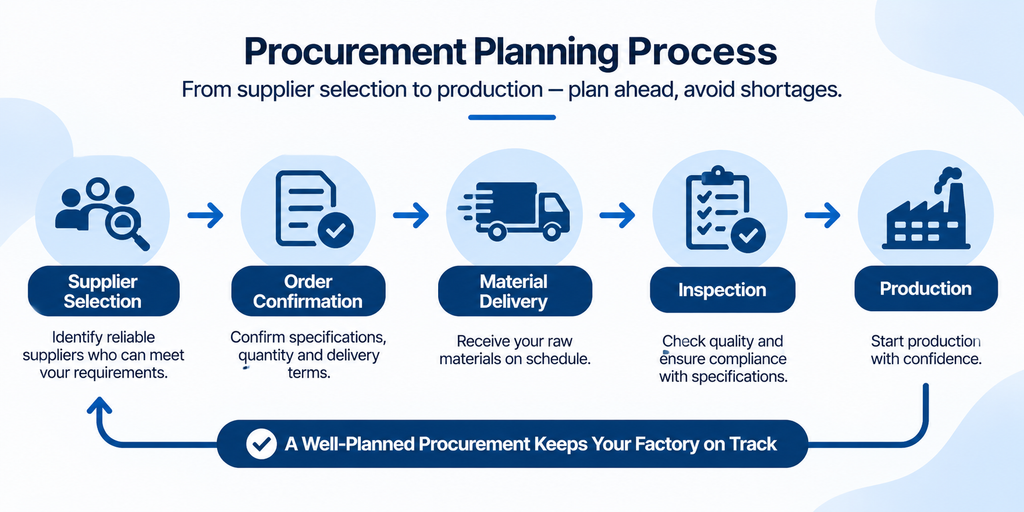
Work backwards from the date your production team needs the material. Allow time for receiving, inspection and approval, then account for supplier preparation, dispatch, transit and clearance where applicable.
For example, if production starts in Week 6, you might reserve Week 5 for receipt and inspection, allocate Weeks 2–4 for supplier preparation and delivery, and confirm the specification and order in Week 1.
This is a hypothetical planning sequence, not a standard delivery schedule. The actual timeline will depend on the material, supplier, origin and transport route.Confirm key milestones with the supplier and establish when you will receive updates if the order falls behind schedule.
This gives your team an opportunity to review production priorities or alternative sourcing arrangements before a shortage stops operations.
Source your production materials through Matta Marketplace
A procurement plan is only as strong as the sourcing options available to support it. Matta Marketplace connects manufacturers and bulk buyers with suppliers of raw materials, chemicals, ingredients and commodities.
When preparing a sourcing enquiry, provide the exact material name, grade or specification, required quantity, delivery location and intended application. Include relevant technical documents where available. These details give suppliers a clearer basis for assessing your requirement and preparing a suitable quotation.Have a material requirement to fulfil? Submit your sourcing requirement through Matta Marketplace


