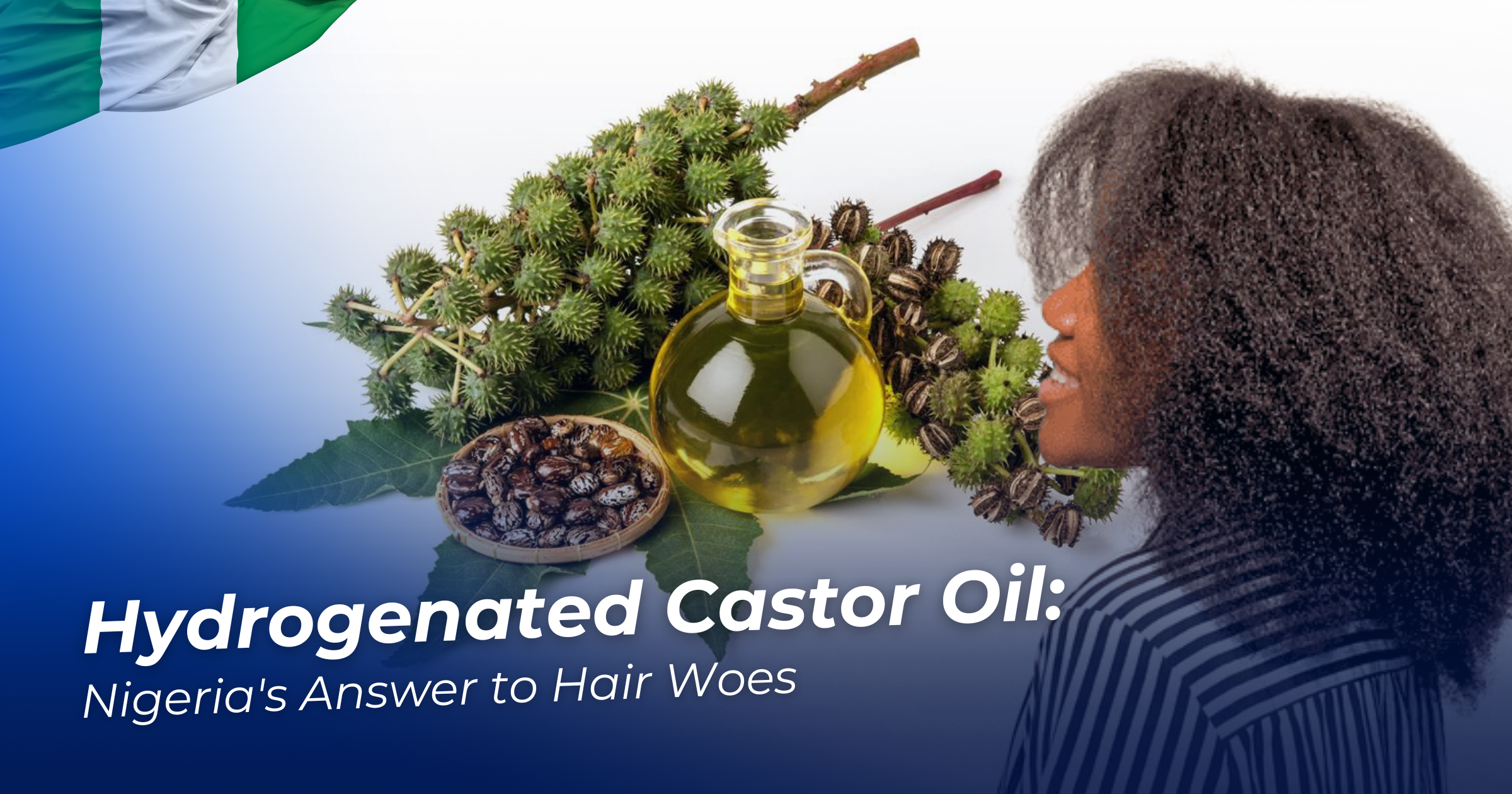
In a world saturated with haircare products and remedies, it’s easy to overlook the hidden gems under our noses—or, in this case, on our scalps. Hydrogenated Castor Oil, a humble yet potent ingredient, has been quietly revolutionizing haircare in Nigeria. As we prepare to delve into this multifaceted subject, brace yourself for an enlightening journey. We’re not just talking about another haircare product; we’re uncovering a cultural, scientific, and aesthetic marvel transforming how Nigerians care for their hair. So, fasten your seatbelts; you’re in for an educational ride.
While Hydrogenated Castor Oil has been celebrated for its skin benefits, its influence extends far beyond that. This article shifts the spotlight to another crucial aspect—haircare.
In a country like Nigeria, where hair is not just a feature but an expression of cultural identity and social standing; Hydrogenated Castor Oil holds a special place.
In Nigeria, hair is more than a mere accessory; it’s a canvas that paints a vivid picture of cultural heritage, personal identity, and social standing.
While traditional haircare practices have their roots deep in Nigerian history, the modern individual is increasingly turning to science-backed solutions that don’t compromise cultural significance. This is where Hydrogenated Castor Oil steps into the limelight.
Long acclaimed for its skincare benefits, this versatile ingredient is now making waves in the realm of haircare.
This article is your comprehensive guide to understanding the what, why, and how of Hydrogenated Castor Oil’s role in transforming haircare in Nigeria.
History of Hydrogenated Castor Oil
Regarding Hydrogenated Castor Oil, there’s more than meets the eye. Derived from the seeds of the Ricinus communis plant, this unique substance undergoes a hydrogenation process that transforms it from a liquid into a semi-solid or solid state. This not only enhances its stability but also amplifies its versatility, making it a sought-after ingredient in a plethora of haircare products.
The use of castor oil dates back to ancient civilizations, but its hydrogenated form is a relatively modern innovation. It combines traditional wisdom with scientific advancements, offering a best-of-both-worlds solution for hair woes.
Hydrogenated castor oil in Haircare
In Nigeria, castor oil has traditionally enriched haircare routines, often mixed with shea butter and coconut oil for potent hair masks and conditioners. Although, recently, hydrogenated castor oil has gained popularity, driven by the shift toward natural and organic products.
As consumers become more aware of synthetic chemicals’ harmful effects, they embrace hydrogenated castor oil for its high fatty acid content and stability. Moreover, its effectiveness in combating dryness, breakage, and thinning makes it a go-to remedy.
Today, hydrogenated castor oil is a household name, featured in numerous commercial haircare products, showcasing its versatility and effectiveness.
Production Process of Hydrogenated Castor Oil
Creating Hydrogenated Castor Oil is a meticulous process that involves several stages, each contributing to its unique properties.
The journey begins with the extraction of oil from the seeds of the Ricinus communis plant, commonly known as the castor bean plant.
This initial oil is then subject to hydrogenation, a chemical process that involves the addition of hydrogen atoms to the oil’s molecular structure.
The result? A more stable, wax-like substance that is less prone to oxidation.
Here’s a step-by-step breakdown:
- Seed Harvesting: The castor bean plant’s seeds are harvested, typically by hand, to ensure quality.
- Cold Pressing: The seeds are cold-pressed to extract the initial castor oil, retaining most of its natural properties.
- Hydrogenation: The extracted oil is then hydrogenated by exposing it to hydrogen gas under controlled temperature and pressure conditions. This transforms the liquid oil into a semi-solid or solid state.
- Purification: The hydrogenated oil undergoes a process to remove impurities, ensuring it meets quality standards.
- Quality Control: Finally, the oil is subjected to rigorous quality control tests to meet cosmetic and medicinal use specifications.
The production process is carefully monitored to ensure that the Hydrogenated Castor Oil retains its beneficial properties while meeting safety and quality standards. This makes it a reliable and effective ingredient in various haircare formulations, especially in a demanding climate like Nigeria’s.
Elements of Hydrogenated Castor Oil That Make It Great for Hair
In summary, the chemical makeup of Hydrogenated Castor Oil is a perfect match for the challenges and needs of diverse hair types, particularly those common among Nigerians.
When it comes to haircare, not all oils are created equal. Hydrogenated Castor Oil stands out due to its unique chemical composition, which offers a range of benefits specifically tailored for hair health. Some of these elements include;
Ricinoleic Acid
Ricinoleic acid This is the ‘star of the show.’ It’s a fatty acid that makes up nearly 90% of Hydrogenated Castor Oil. Also, this acid has anti-inflammatory properties, making it excellent for soothing irritated scalps.
High Viscosity
The oil’s high viscosity helps it adhere to hair strands, providing a natural layer of protection against environmental factors like sun and wind.
Antimicrobial Properties
It also possesses antimicrobial properties, which can help combat scalp infections that lead to dandruff and other conditions.
Rich in Nutrients
Hydrogenated Castor Oil is rich in nutrients like vitamin E and omega-6 fatty acids, contributing to its moisturizing and nourishing capabilities.
pH-Balancing
Interestingly, the oil has a pH level close to human hair, effectively restoring the hair’s natural pH balance.
Sealant Qualities
Its ability to seal in moisture makes it particularly effective for curly or textured hair types prone to dryness and breakage.
Close Alternatives to Hydrogenated Castor Oil for Hair
While Hydrogenated Castor Oil has carved a niche for itself, it’s not the only player in the game. Some other oils and ingredients offer similar benefits for hair health. Here’s a look at some of them:
Coconut Oil
Rich in lauric acid and possessing a similar fatty acid profile, coconut oil is often used as a deep conditioner and moisturizer for hair.
Jojoba Oil
With a chemical structure resembling human sebum, jojoba oil is another popular alternative for scalp treatments and hair conditioning.
Argan Oil
Known as ‘liquid gold,’ argan oil is also rich in antioxidants and vitamin E, making it a go-to for adding shine and softness to hair.
Shea Butter
This natural fat extract from the shea tree is commonly used in Nigeria for skin and hair care. It offers deep moisturization and has a natural SPF.
Olive Oil
Packed with antioxidants and hydrating squalene, olive oil is often used in DIY hair masks and as a natural conditioner.
Avocado Oil
Rich in monounsaturated fats, avocado oil can penetrate the hair shaft more deeply compared to other oils, offering intense hydration.
While these alternatives offer similar benefits, Hydrogenated Castor Oil stands out for its unique properties like high ricinoleic acid content and pH-balancing capabilities, making it a versatile and effective choice for various haircare needs.
Benefits of Hydrogenated Castor Oil for African Hair Textures
African hair textures are incredibly diverse, ranging from wavy and curly to tightly coiled. These textures have unique needs, and Hydrogenated Castor Oil is well-suited to meet them.
Let’s highlight some benefits of this chemical, especially for African hair types;
Promoting Growth and Thickness
One of the most sought-after benefits is its ability to promote hair growth and thickness. The oil’s ricinoleic acid helps improve blood circulation in the scalp, stimulating hair follicles and encouraging growth.
Combatting Breakage and Dryness
African hair textures are often prone to dryness and breakage. Hydrogenated Castor Oil acts as a potent moisturizer, sealing in moisture and preventing split ends.
Enhancing Natural Shine
The oil’s fatty acids help to reflect light, giving hair a natural shine that enhances its appearance without making it greasy.
Scalp Health
The anti-inflammatory and antimicrobial properties of the oil make it excellent for maintaining a healthy scalp, which is crucial for hair growth and overall health.
Versatility in Styling
Its semi-solid consistency makes it a great styling agent, offering hold without stiffness, which is particularly useful for maintaining natural hairstyles like twists and braids.
Protective Barrier
Lastly, the oil forms a protective barrier around the hair shaft, shielding it from environmental damage like sun exposure and pollution.
Hydrogenated Castor Oil is like a Swiss army knife for African hair textures, offering a range of benefits that address the unique challenges these hair types face.
Conclusion: Hydrogenated Castor Oil—Nigeria’s Answer to Hair Woes
From its humble origins as a traditional remedy to its modern-day status as a haircare powerhouse, Hydrogenated Castor Oil has repeatedly proven its mettle. Its unique chemical composition makes it a versatile and effective solution for various haircare needs, particularly those relevant to Nigeria’s diverse and beautiful African hair textures.
As we’ve seen, this remarkable ingredient is not just a trend but a mainstay, deeply rooted in cultural practices and modern science. Its role in the burgeoning natural hair movement, its alignment with sustainability goals, and its adaptability to future industry trends make it more than just an ingredient; it’s a testament to Nigeria’s evolving narrative of beauty and self-care.
So, whether you’re battling dryness, seeking growth, or simply looking for a natural alternative to chemical-laden products, Hydrogenated Castor Oil offers a promising and effective solution. It’s not just an answer to hair woes; it’s a statement of what beauty and care can be—natural, effective, and deeply rooted in cultural heritage.
FAQs
1. How does the hydrogenation process alter the fatty acid profile of castor oil?
Hydrogenation saturates the unsaturated fatty acids in castor oil, making it more stable and less prone to oxidation. This enhances its shelf life and makes it more suitable for cosmetic formulations.
2. Can Hydrogenated Castor Oil act as a surfactant?
Hydrogenated Castor Oil can act as a non-ionic surfactant due to its unique fatty acid composition, making it useful in formulations requiring emulsification or foaming properties.
3. How does the pH level of Hydrogenated Castor Oil affect hair health?
The pH level of Hydrogenated Castor Oil closely mimics that of human hair, helping to maintain the hair’s natural pH balance, which is crucial for cuticle integrity and overall hair health.
4. Is there a chirality concern with Hydrogenated Castor Oil?
No, the hydrogenation process eliminates any chirality concerns, making the oil more uniform and predictable in its interactions with other ingredients.
5. Can Hydrogenated Castor Oil mitigate the effects of hard water on hair?
Yes, its chelating properties can help to neutralize the minerals found in hard water, thus reducing build-up and improving the effectiveness of other haircare products.
6. How does Hydrogenated Castor Oil interact with protein treatments?
The oil’s high fatty acid content can enhance protein penetration into the hair shaft, making protein treatments more effective.
7. Can it be used in “clean beauty” formulations?
Hydrogenated Castor Oil aligns well with the clean beauty ethos, given its natural origins and minimal processing requirements.
8. Does Hydrogenated Castor Oil have any electromagnetic properties that are beneficial for hair?
While not electromagnetic per se, its high dielectric constant makes it an excellent insulator, helping to maintain hair’s natural electrical balance.
9. How does Hydrogenated Castor Oil affect hair porosity?
Its sealing properties make it effective for both low and high-porosity hair types, as it can lock in moisture and prevent excessive water absorption.
10. Can Hydrogenated Castor Oil be used in hair colour formulations?
Its stability and emollient properties make it an excellent ingredient in hair colour formulations, which can help distribute colour and increase durability evenly.
11. Is it compatible with silicones commonly used in hair care?
Hydrogenated Castor Oil is generally compatible with silicones and can even enhance their spreadability and effectiveness.
12. Can it act as a UV protectant for hair?
While not a substitute for dedicated UV protectants, its natural fatty acid composition does offer some degree of UV protection